For eleven years I wasn't the man on the truck. I was the man in the office who wrote the price book and trained the technicians on what to say in your kitchen. Here is every repair, every real part price, and all fifteen scripts — written down by the person who taught them.
See What's Inside ↓
Twelve repairs you can do with a screwdriver and a garden hose. Fifteen sales scripts decoded line by line. What every part actually costs at the counter. And the emergency-heat plan I wish my neighbours had in February 2021.

Every repair I approved.
Every price I marked up.
Every script I taught.
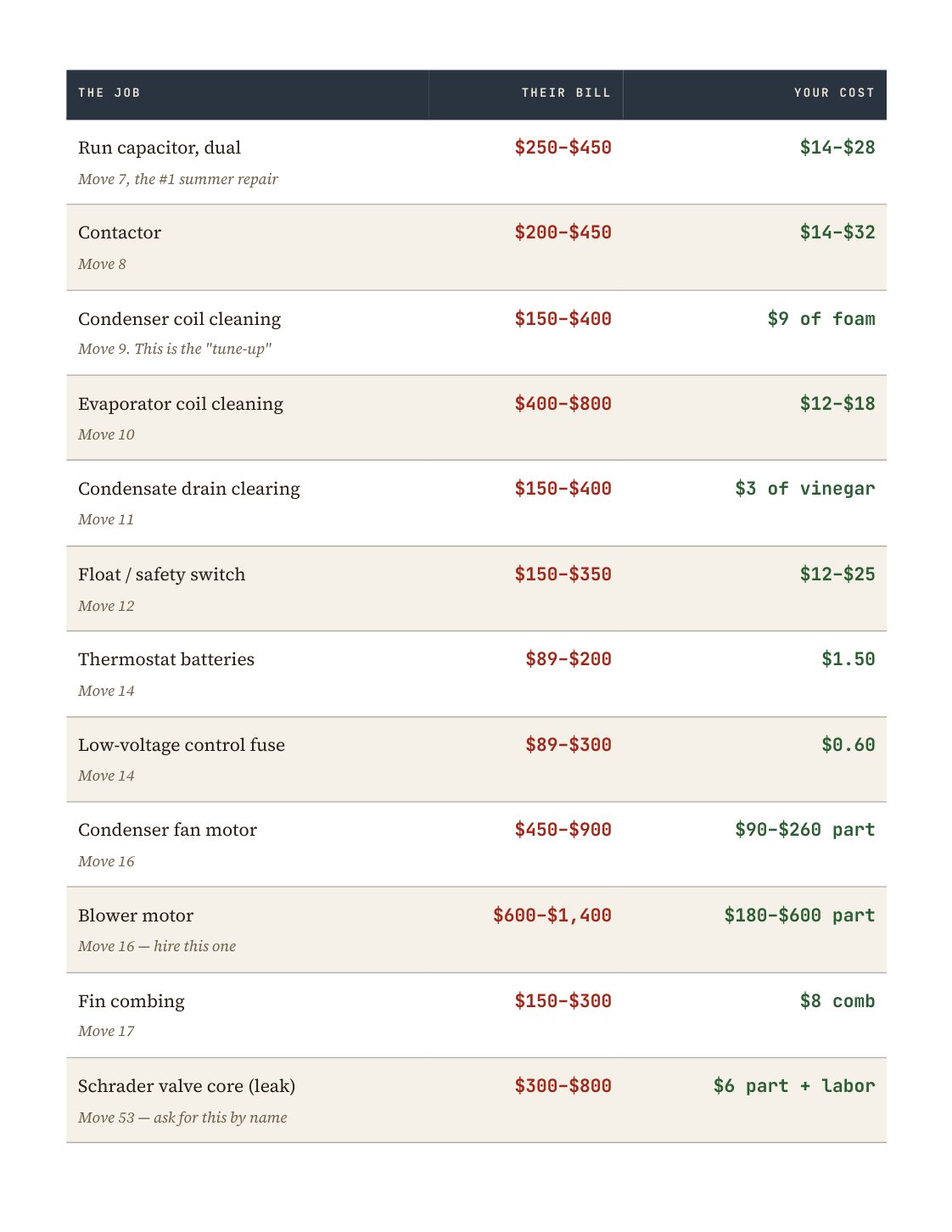
Every other book stops at the first two columns. I sat in the meetings where the third one was written. These are typical U.S. prices for 2026 — the same published cost guides the contractors read.
| The job | Their bill | The line they use | Real cost |
|---|---|---|---|
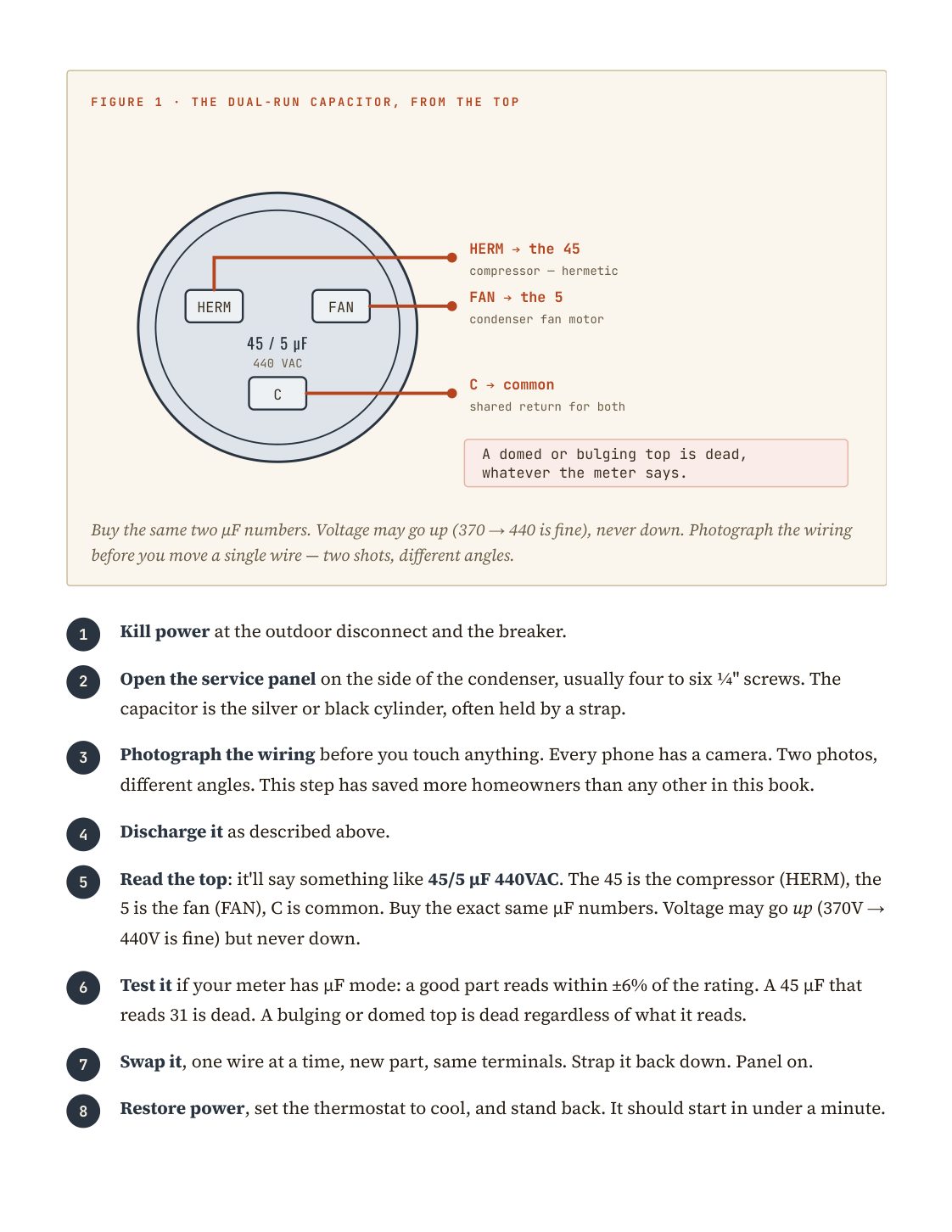
| Run capacitorThe #1 summer repair | $250–$400 | "When one goes, the compressor's usually been running stressed…" | $16 part |
| Seasonal "tune-up" plan22 minutes of actual work | $150–$400/yr | "The maintenance plan pays for itself." | $9 of foam |
| Yearly refrigerant "top-off"A sealed system cannot use refrigerant | $300–$600/yr | "You've got a slow leak — we can top it off." | Fix the leak once |
| ContactorA relay with burnt contacts | $200–$450 | "That's a sealed system component." | $22 part |
| Clogged drain / tripped floatThe system shut itself off on purpose | $150–$400 | "Your safety switch tripped — we'd need to evaluate." | $3 of vinegar |
| Thermostat batteries or a 60¢ fuseYes, really | $89–$300 | "Complete system failure." | $1.50 |
| Panic replacement in AugustQuoted at 96° indoors | $9,000–$14,000 | "R-410A is being phased out — parts will get scarce." | Years more life |
One capacitor caught at its real price pays for this book ten times over. One refused "top-off" saves you that every single year. And knowing one script in August can be the difference between a $37 book and a $12,000 financing agreement.
Sources: national cost guides (Angi, HomeGuide, HomeAdvisor), HVAC distributor and retail part pricing, U.S. Department of Energy and ENERGY STAR guidance, EPA Section 608 and AIM Act rules, ACCA Manual J, and the FTC Cooling-Off Rule — 2026. Your market will vary.
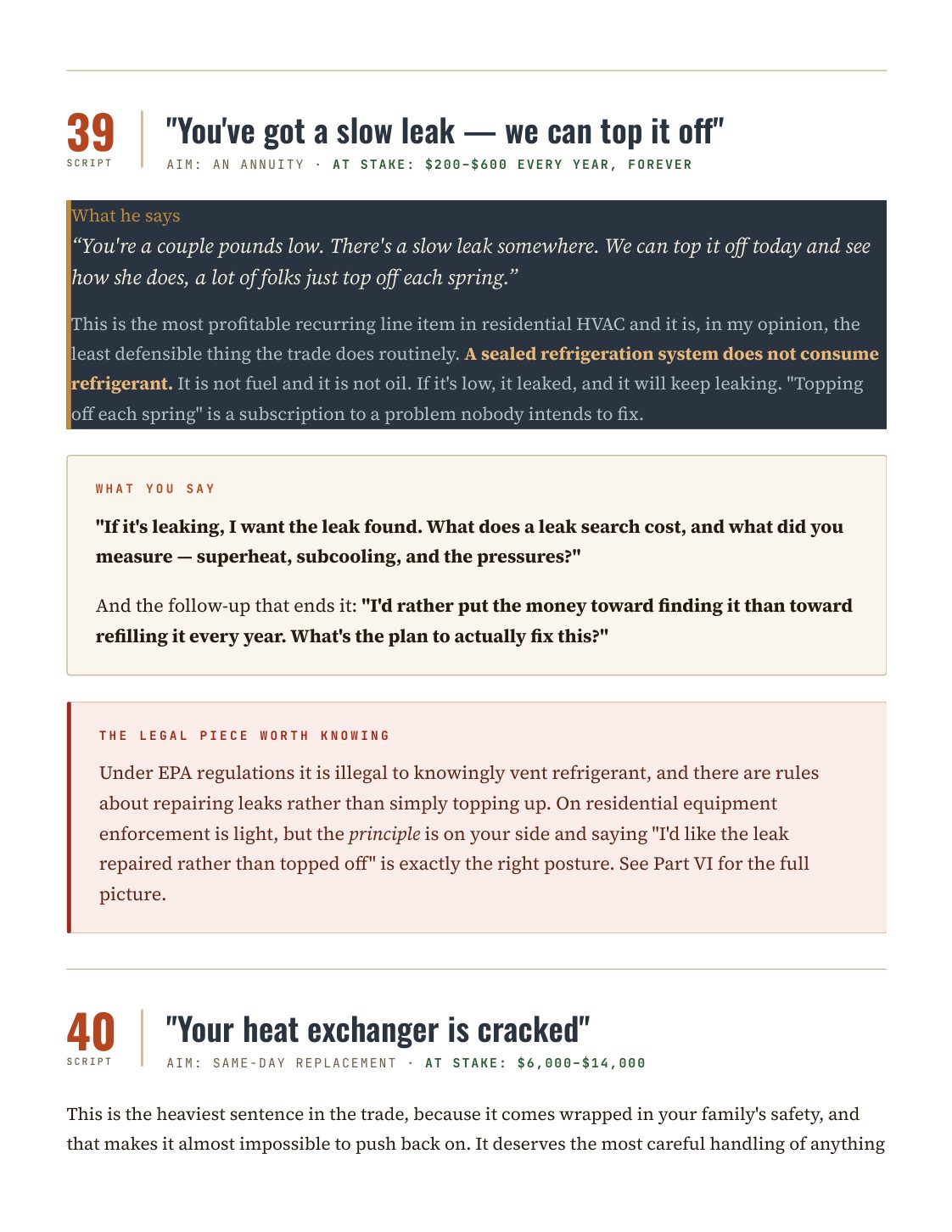
We ran role-play on Tuesday mornings. Some of these are printed word for word in the book, along with what each one is actually after and exactly what you say back. Here are three of them.
I found a crack in your heat exchanger. That's a carbon monoxide risk — I have to red-tag this. I wouldn't let my family sleep here tonight.
What makes this the heaviest sentence in the trade is that it is sometimes completely true, and when it's true it's genuinely serious. Which is exactly why it also gets used when it isn't — no homeowner will gamble against it. What you say: "Show me. Take a photo with the inspection camera and send it to me."
R-410A is being phased out. Parts and refrigerant for your system are going to get scarce and expensive. You want to get ahead of this.
The regulation is real — new equipment moved to R-454B in 2025. What's smuggled in is the word your. The rule restricts manufacturing new equipment, not servicing what you already own. What you say: "Is R-410A still available to service my existing system — yes or no?" Make him say yes. The urgency evaporates.
Don't get hung up on the total — nobody pays cash for these. It's a hundred and eighty-nine a month. Less than most folks' phone bill.
The moment the conversation moves from price to monthly payment, you have lost the ability to compare quotes at all. $189 × 120 months is $22,680 on an $11,000 system. What you say: "What's the cash price, the APR, the term, and the total of payments?"
The other twelve are in Part V — along with the seven words that end a same-day close before it starts.
Read it once front to back, then keep it on your phone and pull up whatever's broken.

I started in 1996 as an apprentice hauling a recovery machine up attic ladders in August. Made lead technician, and in 2010 they made me Service Manager over twelve men in San Antonio.
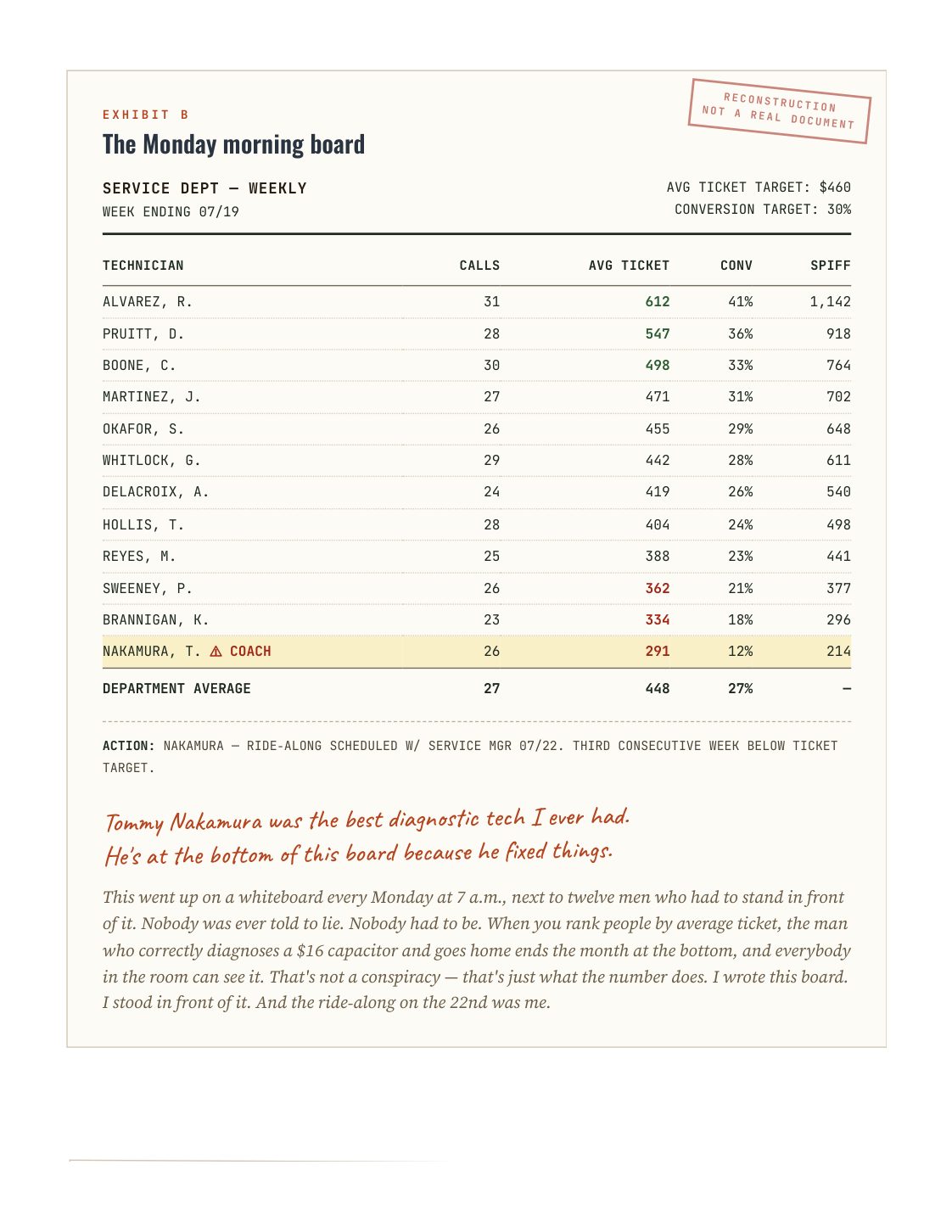
That job had almost nothing to do with air conditioning. My job was average ticket — the average dollar amount per service call. Every Monday it went up on a whiteboard next to twelve names. I wrote the price book. I ran the Tuesday role-play. A capacitor cost us $9.40 at the supply house and the book said $389, and nobody in that room thought that was strange.
In February 2021 the grid went down and I watched us quote eight thousand dollars for jobs that were an afternoon. I started telling people. In November they walked me out.
"He knows how to explain this to normal people. That's why I told him to make the videos. Every time he wrote something in this book I couldn't follow, I made him write it again — and my notes are in there too, all the way through."
The Straight-Answer Guarantee. Read it for seven days. If it doesn't show you how to save several times what you paid, reply to your receipt and I'll refund every cent — no questions, no forms, no hard feelings. Keep the book either way. It pays for itself, or it's free.
Five people were sent the manuscript before release. These are their words, unedited. They are readers of the draft, not customers — nobody has bought this book yet, because it is out today.
The biggest value of this book is that it teaches you how to slow down an expensive decision. The chapter on sales scripts made me realize how much pressure can be created simply by saying a price is good for today. I don't need to become an HVAC expert. I just need to know enough to ask better questions before spending thousands of dollars.

This book completely changed the way I look at an HVAC service call. I used to assume that whatever number the technician gave me was the number I had to accept. Now I know what questions to ask, what measurements matter, and why I should never feel pressured to make a same-day replacement decision. The section on pricing alone was worth the cost of the book.

I bought this because I wanted to understand HVAC costs, but I ended up getting something much more useful: a way to think clearly when someone is asking me for thousands of dollars. The scripts are practical, especially the advice to ask for actual readings and a written quote with model numbers. It gives you confidence without turning you against every technician.

What I liked most is that this doesn't pretend every HVAC problem is a DIY project. It explains what you can safely check yourself and tells you when to hire a professional. The combination of real pricing, measurements, and simple explanations makes this one of the most useful homeowner guides I've read.

The refrigerant section was the biggest eye-opener for me. I never really understood what "low on refrigerant" meant or what questions I should ask. Now I know to ask about the leak, the measurements, and the actual repair plan instead of simply agreeing to another refill.

Especially for you. Roughly half the book needs no tools — it's knowing what things should cost and what to say when a truck is in your driveway. Part V is fifteen sentences and about forty minutes of reading, and it's worth more than every wrench in your garage. The hands-on parts use a screwdriver, a garden hose and a jug of vinegar, with the safety steps spelled out at every stage.
It covers standard central air conditioning, gas furnaces, and heat pumps — what the large majority of U.S. homes run. The pricing tables, the scripts, and the buying chapter apply no matter what's in your yard, including if you're on a mini-split or a rental.
Other books teach you the repair, and that's the easy half. I spent eleven years as the Service Manager who wrote the price book and trained the technicians on what to say in your kitchen. Nobody else can hand you those fifteen scripts, because nobody else taught them.
Usually the first time a truck is in your driveway. Catching one capacitor at its real price covers the book more than ten times. Refusing one annual refrigerant "top-off" covers it every year after that.
Everything hands-on in the book is homeowner-level maintenance — the same cleaning and checks a paid tune-up performs. Anything that legally needs a license — refrigerant, gas piping, flue work, anything inside the electrical panel — is clearly marked HIRE IT OUT, with how to hire it without being overcharged. About a third of the book ends in "call somebody," and I'd rather tell you that plainly than sell you a fantasy.
A PDF, delivered to your email within a minute of purchase. Read it on any phone, tablet or computer, and print the four cards from Part IX. No app, no subscription, no DRM. Yours forever, including every future edition.
Seven days, no questions. Reply to your receipt and I'll refund every cent, and you keep the book. I'd rather have that than your money.
Skip one padded diagnostic and the book has paid for itself. Catch one $250 capacitor at its $16 price and you're up hundreds. Refuse one "top-off" and you're up every year.